
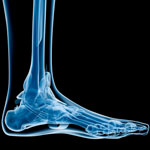


Leg, Ankle & Foot Injuries
Sports injuries associated with the leg, ankle and foot along with related injury treatments and surgeries.
Achilles tendinopathy can be an inflammation of the peritenon around the Achilles tendon or an area of tendinosis within the Achilles tendon. It is a common cause of posterior leg and ankle pain in athletes and active individuals. Typically it causes pain along the Achilles tendon with activity, but it can start to affect activities [...]
+Continue Reading
Achilles tendon ruptures are very debilitating injuries to the ankle. These injuries can occur to the adult population outside of sports, but it is unfortunately not uncommon in athletes. Most commonly it involves athletes in their thirties. Usually the injury involves some sort of running event, such as a sudden stop or start or a [...]
+Continue Reading
Ankle impingement can occur after traumatic ankle sprains or even fractures. Typically the capsule and synovial lining of the ankle joint get inflamed and can develop scar tissue in either the anteromedial gutter or anterolateral gutter between the ankle bones. This irritation and hypertrophy of the tissue can cause pain with ankle dorsiflexion and subsequently [...]
+Continue Reading
Ankle fractures are common injuries to athletes in contact and collision sports. There are multiple types of ankle fractures including fractures of the lateral malleolus (the bone on the outside of the leg and ankle) and the medial malleolus (the bony prominence on the inside of the ankle). An ankle fracture typically results from a [...]
+Continue Reading
An ankle sprains is one of the most common injuries in all of sports, affecting amateur and pro athletes alike. The injury involves stretching or tearing the ligaments around the ankle. It can be a minor nuisance to the athlete, affecting activity for a couple of days, or it can be a source of long-term [...]
+Continue Reading
Stress fractures are common overuse injuries, and fractures of the calcaneus, or heel bone, are especially common in running athletes. Typically the runner will complain of pain that initially starts after a certain amount of running but gets better with rest. As the problem gets worse, he or she will have pain earlier in the [...]
+Continue Reading
Chronic exertional compartment syndrome is an uncommon source of pain and disability in athletes. Most frequently, it causes leg pain in running athletes, but occasionally it is seen in the forearms of throwing athletes, such as pitchers. In the leg, it is often misdiagnosed as the more common shin splints or stress fractures. Compartment syndrome [...]
+Continue Reading
The majority of stress fractures of the metatarsal bones are similar to the ones described in the injury post on metatarsal stress fractures. These typically occur in the middle or distal portion of the fifth metatarsal (the one closest to the outside of the foot). A more worrisome location for an injury to this bone [...]
+Continue Reading
Tendinitis of the flexor hallucis longus is an unusual source of ankle pain, but it is frequently seen in ballet dancers. Typically ballet dancers will complain of pain in the posterior aspect of the ankle. A sports medicine physician can often make this diagnosis by palpating the flexor hallucis longus tendon as it passes behind [...]
+Continue Reading
Hallux rigidus is a painful condition of the first metatarsophalangeal joint, or what many people consider the ball of the foot. It is a degenerative condition in which bone spurs develop at this joint and the joint space narrows. It can occur after a traumatic event to the great toe, or it can result from [...]
+Continue Reading
Lateral ankle instability can result from an ankle sprain where the anterior talofibular ligament and sometimes the calcaneofibular ligament do not heal completely. Lateral ankle instability often describes a chronic condition where these ligaments are unstable. Symptoms of giving way with normal walking or walking on uneven surfaces are common in these athletes. The sports [...]
+Continue Reading
Lisfranc injuries of the foot are very uncommon in sports, but they can be very debilitating. These are injuries in which a ligament in the midfoot is injured. When the Lisfranc ligament is ruptured, the first and second metatarsals (the long bones of the midfoot) or other bones in the midfoot can separate. Lisfranc injuries [...]
+Continue Reading
The metatarsals are the long bones in the middle of the foot. They are prone to overuse injuries, especially in running sports and dancing. Stress fractures are painful injuries to runners and dancers, and they significantly limit the athlete’s ability to participate in those sports. Usually the athlete will not remember a specific injury that [...]
+Continue Reading
Of all the stress fractures that can occur in the lower extremities of athletes, one of the least common, but unfortunately most serious, is a stress fracture of the navicular. This is a bone in the midfoot toward the inside of the foot. Stress fractures of the navicular occur in running and jumping athletes, such [...]
+Continue Reading
Osteochondral lesions of the talus are uncommon sources of ankle pain in athletes that can occur after traumatic ankle sprains. They are often found incidentally on ankle x-rays obtained for ankle sprains or to rule out ankle fractures. In patients and athletes with pain in the ankle joint from a presumed ankle sprain but with [...]
+Continue Reading
One of the uncommon injuries that occurs to the ankle in sports involves the peroneal tendons. These are the tendons that are located behind the lateral malleolus, or the bone on the outside of the ankle. These tendons help turn the foot outward. Although rare, these injuries can occur in sports. The common mechanism of [...]
+Continue Reading
Plantar fasciitis is one of the most common causes of heel pain in athletes and non-athletes alike. Typically it comes about without any inciting event or trauma, although it can occur after events such as sudden exertion. It often manifests as pain at the base of the heel on the sole of the foot rather [...]
+Continue Reading
Sever’s disease is a common cause of heel pain in young athletes. It’s typically seen in kids ranging from 8 to 15 years old. It is common in sports that involve running, such as soccer, and repetitive impact, such as gymnastics. It is an inflammation or irritation of the growth plate on the back of [...]
+Continue Reading
Shin splints are somewhat of a generic term for pain in the tibia, or shin bone. Typically runners are most commonly affected, but it can occur in any repetitive impact sport. Other causes of leg pain are covered in the posts on chronic exertional compartment syndrome and stress fractures, so in discussing shin splints, we [...]
+Continue Reading
A syndesmosis ankle injury is what most athletes know as a “high ankle sprain.” It is a source of some confusion, especially in terms of how it relates to the length of time it takes an athlete to get back to sports. It’s a very common injury in cutting and pivoting sports that involve changing [...]
+Continue Reading
One of the most painful injuries in all of sports is a broken bone. A fracture of the tibia (shin bone) is one of the worst examples. Typically, tibia fractures occur with high velocity injuries, such as motor vehicle accidents, and are fairly uncommon in sports. They can occur in contact and collision sports, such [...]
+Continue Reading
A tibial stress fracture is a fortunately uncommon cause of leg pain in athletes, especially running athletes or those who participate in repetitive landing from a jump, such as gymnastics. Typically athletes complain of pain that increases over a period of time, usually in response to increased stress. A common story is a runner who [...]
+Continue Reading
Turf toe is a hyperextension injury to the metatarsophalangeal joint of the hallux, or the ball of the foot on the great toe. It is unfortunately a fairly common injury in football, but it can occur in other sports, such as basketball and soccer, as well. It is called turf toe because early studies on [...]
+Continue Reading