How does a pectoral tendon rupture occur? How should you treat the injury? Are there risk factors that put you at risk for a pectoral injury?
Andy from Prestwick in Ayrshire, Scotland asks:
I came across your website and wondered if you have ever treated someone for a pectoral tear who has undergone rotator cuff surgery on the same side of the body before?
I suspect I have a pectoral tear (I was bench pressing) and show all the symptoms. I am a little worried though, as on the same side as the tear I had rotator cuff surgery around 11 years ago.
Pectoral tendon rupture
This question really addresses two separate but interrelated topics. First of all, there is the question of the current injury. Pectoral tendon tears are almost always acute events, meaning that a specific injury occurs to initiate the injury. In my experience these injuries almost always occur in people doing a bench press (although I have personally witnessed it when someone was doing dumbbell flies).
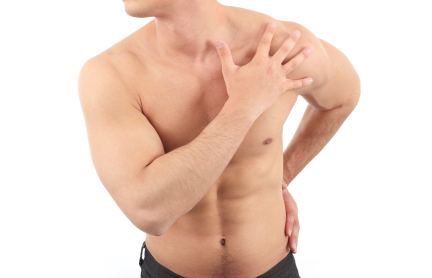
Mechanism of injury of a pectoral tendon rupture
The injury is a very quick event, either in the rapid action of pushing the weight up or letting the weight down. It is not a subtle event either, as the athlete will often notice a sharp tearing sensation. If you see one of these injuries, or you are a doctor who sees the patient within the first few hours after the injury, you will see bruising in the chest wall, shoulder, and upper arm almost immediately. Many times you can feel a defect where the injury occurs.
I think the trend is slowly turning to more aggressive treatments for pectoral tendon injuries. By that I mean that more sports medicine surgeons are choosing to repair these surgically. We have always fixed tendon avulsions from the bone of the upper arm. I think the trend is getting to even be more aggressive with treating partial tendon injuries. I recommend that someone who appears to have a pectoral tendon injury see a physician quickly and potentially get an MRI. The MRI can help show if this is an injury within the pectoral muscle belly (which often does not need to be fixed surgically), or whether it’s a tear at the muscle-tendon junction or an avulsion of the tendon itself. Knowing the location and extent of the injury can help guide treatment and rehabilitation. In general, surgery can help restore full strength for someone who uses these muscles actively.
Risk factors for a pectoral tendon rupture?
The question as to whether or not an athlete is predisposed to an injury of a body part based on a prior injury to that body part is a complicated one. Certainly it makes sense. If someone has an injury or even surgery but never completely regains range of motion or strength to protect and stabilize the joint, he or she might be more likely to suffer an injury. With pectoral tendon injuries, they are almost always based on an explosive movement, so they’re much more likely to occur as isolated events.

I have seen patients with new pectoral tendon injuries after they have had a prior labral repair. It makes sense that this would be the more likely prior event, as labral tears more likely occur in younger athletes, such as contact or collision athletes who suffer shoulder dislocations or throwing athletes who suffer superior labral tears. Full-thickness rotator cuff tears that need to be repaired (as opposed to partial tears that might just need debridement) are almost always more common in older athletes. Full-thickness rotator cuff tears almost always occur in patients over 50, barring some traumatic event. While it is certainly possible that someone with a prior rotator cuff repair tears his pectoral tendon, it would not be as likely as someone with a prior labral repair, in my opinion.
Regardless, in the setting of a prior injury and/or surgery and a new injury to the shoulder, I think that it is always a good idea to have the new injury evaluated. It may turn out not to be serious, and the athlete might return to exercise quickly. But it’s worth learning if it’s an injury that can be made worse or needs surgery to repair it within the first few days or weeks.
Recommended Products and Resources
Click here to go to Dr. David Geier’s Amazon Influencer store!
Due to a large number of questions I have received over the years asking about products for health, injuries, performance, and other areas of sports, exercise, work and life, I have created an Amazon Influencer page. While this information and these products are not intended to treat any specific injury or illness you have, they are products I use personally, have used or have tried, or I have recommended to others. THE SITE MAY OFFER HEALTH, FITNESS, NUTRITIONAL AND OTHER SUCH INFORMATION, BUT SUCH INFORMATION IS DESIGNED FOR EDUCATIONAL AND INFORMATIONAL PURPOSES ONLY. THE CONTENT DOES NOT AND IS NOT INTENDED TO CONVEY MEDICAL ADVICE AND DOES NOT CONSTITUTE THE PRACTICE OF MEDICINE. YOU SHOULD NOT RELY ON THIS INFORMATION AS A SUBSTITUTE FOR, NOR DOES IT REPLACE, PROFESSIONAL MEDICAL ADVICE, DIAGNOSIS, OR TREATMENT. THE SITE IS NOT RESPONSIBLE FOR ANY ACTIONS OR INACTION ON A USER’S PART BASED ON THE INFORMATION THAT IS PRESENTED ON THE SITE. Please note that as an Amazon Associate I earn from qualifying purchases.
Podcast: Play in new window | Download